Monte Carlo Simulations for Blockchain: Technical Guide
Monte Carlo simulation is a crucial mathematical tool for modeling uncertainty. Applied to crypto-asset markets, it allows for simulating thousands of possible price paths to estimate the risk of "tail events" (Black Swan events).
| Simulation Parameter | Blockchain Reality | DCM Core Modeling |
|---|---|---|
| Price Distribution | Fat Tails & High Skewness | Lévy / Jump-Diffusion Models |
| Volatility | Extreme volatility clustering | DLT-adapted GARCH Models |
| Correlation | Non-linear dependencies | Clayton / Gumbel Copulas |
1. Modeling Crypto Volatility
Unlike traditional equity markets, digital asset price trajectories often exhibit thick tails (*fat tails*). Our simulations integrate jump-diffusion models to capture the sharp volatility spikes frequent in the blockchain ecosystem, ensuring compliance with EBA (European Banking Authority) stress-testing requirements for stablecoins and RWA.
# Simplified pseudo-code of a path simulation
def simulate_dlt_price(S0, T, r, sigma, jumps):
    # S0: Initial price
    # T: Time horizon
    # sigma: Volatility
    # jumps: Frequency of extreme events
    ...
    return price_path
2. Stress Testing Liquidity Pools (DORA Resilience)
For RWA (Real World Assets) or stablecoins, we use Monte Carlo to simulate mass withdrawals and secondary market de-pegging. This validates whether reserves and redemption mechanisms are sufficient to maintain the *peg*—a critical requirement for MiCA Asset-Referenced Tokens (ARTs).
3. The DCM Core Advantage
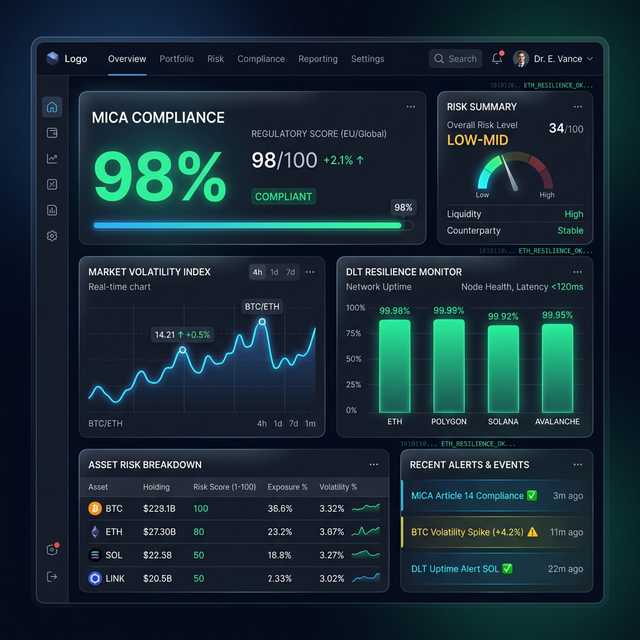
DCM Core is not just a dashboard. Our risk engine allows you to inject these simulations directly into your governance processes. A negative simulation result can, for example, automatically trigger an alert or a temporary freeze of certain trading limits via our governance smart contracts.
Technical Simulation FAQ
Simulate Your Risks with Tier-1 Precision
DCM Core integrates advanced Monte Carlo engines for stress-testing your digital portfolios.
Read the full guide: Blockchain Model Risk Management (MRM)
Complete the cycle with the 360 MRM Guide or return to the Strategic Hub.