Blockchain Model Risk Management (MRM): The Institutional Guide
In the highly regulated financial sector, **Model Risk Management (MRM)** is the cornerstone of prudential stability. With the emergence of digital assets, institutions must adapt their validation frameworks to capture the unique risks inherent in distributed ledger technology (DLT) protocols.
1. The Pillars of MRM for Digital Assets
A robust MRM framework for blockchain rests on three critical dimensions that DCM Core automates through its **Governance OS**:
| Indicator | DLT MRM Standard | Source / Methodology |
|---|---|---|
| Value at Risk (VaR) | Includes on-chain liquidity shocks | Monte Carlo Simulations |
| Stress Tests | Protocol "Jump-to-Default" scenarios | DCM Simulation Engine |
| Correlation | Defines cross-asset contagion risk | Dynamic matrix analysis |
DCM Core ensures total coverage by reinforcing validation across these key areas:
- Conceptual Validation: Is the model suited to the programmable nature of the asset?
- Data Integrity Verification: Are oracles and on-chain feeds resistant to manipulation?
- Continuous Backtesting: Does the model survive periods of extreme crypto volatility?
2. Why Traditional MRM Fails with DLT?
Classic financial models often assume continuous markets and centralized liquidity. Blockchain introduces exogenous variables such as **gas fees**, **probabilistic finality**, and **smart contract risks**. Ignoring these factors in your MRM exposes the institution to unexpected capital losses.
3. The DCM Core Approach: "Trust-as-Code"
We believe that risk validation must be as dynamic as the markets it monitors. By using **executable scenarios**, DCM Core enables Risk Officers to transform regulatory prose into automated stress tests that run 24/7.
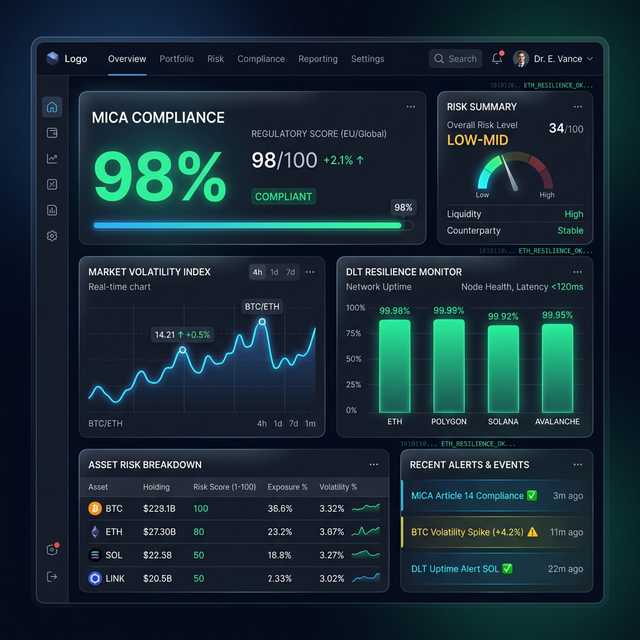
Executive Brief: Risk & Capital (2026)
A strategic guide on capital optimization and market risk management for digital assets.
Download PDF (Sample)Model Risk Management FAQ
Reliability for Your DLT Financial Modeling
DCM Core automates backtesting and validation of your quantitative models for full banking compliance.
Next step: Explore the Impact on Regulatory Capital or return to the Resource Center.