Impact of DLT on Regulatory Capital and MRM
The adoption of Distributed Ledger Technology (DLT) by financial institutions is not just a technological challenge; it is a **capital** issue. Regulators, particularly through the BCBS (Basel Committee on Banking Supervision), impose strict capital requirements that depend on the accuracy of your risk models.
| Risk Component | DLT / Blockchain Impact | Capital Implication |
|---|---|---|
| Credit Risk | Collateral tokenization, auto-liquidation | Potential margin reduction |
| Operational Risk | Smart Contracts, DLT network outages | New prudential buffers required |
| Liquidity Risk | 24/7 markets, DEX fragmentation | Increased LCR requirements in crypto |
1. Operational Risk vs. Market Risk
DLT transforms part of traditional market risk into operational risk. Model validation must therefore extend to cover protocol robustness. A smart contract flaw is not just a technical failure; it is a direct capital risk if the model fails to anticipate it.
2. Reducing Capital through Model Validation
By demonstrating a rigorous and automated **Model Risk Management** framework, banks can justify a reduction in imposed safety margins. DCM Core provides the auditable evidence necessary to validate the accuracy of VaR (Value at Risk) calculations on digital assets.
3. Toward Real-Time Capital Management
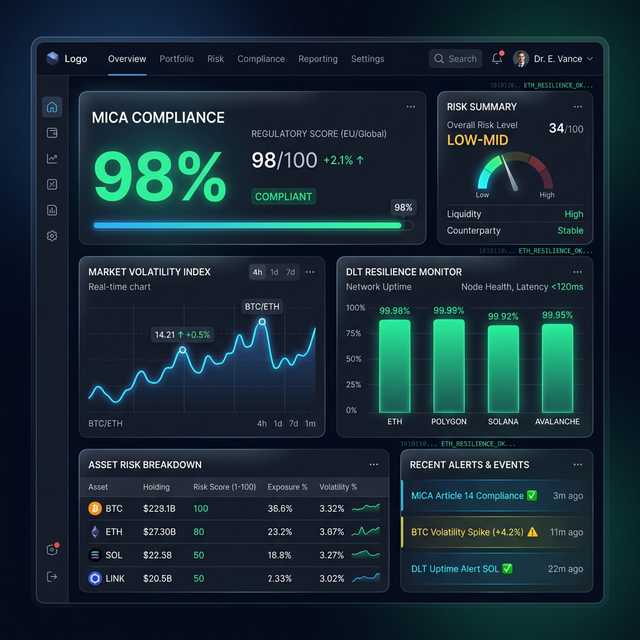
Through DCM Core's direct integration with on-chain feeds, Risk Officers can monitor their capital adequacy dynamically. This allows for an optimized allocation of the institution's resources.
Capital & Regulation FAQ
Optimize Your Regulatory Capital
Discover how DCM Core helps banks reduce surcharges through certified model validation.
Read the full guide: Blockchain Model Risk Management (MRM)
Continue with Model Validation or return to the Strategic Hub.