Model Risk Management (MRM) under MiCA: A Quantitative Guide
With **MiCA** now in force, attention is shifting to the quantitative engines driving digital assets. Model Risk Management (MRM) is no longer confined to traditional credit departments.
1. Model Validation for Stablecoins (ART)
Issuers of Asset-Referenced Tokens (ART) must demonstrate that their reserve management models are robust.
| Feature | Traditional MRM | MRM under MiCA (DLT) |
|---|---|---|
| Data Source | Market indices, Ratings | On-Chain Data (Mempool, DEX) |
| Stress Frequency | Quarterly / Annual | Continuous / Real-Time |
| Specific Risks | Market, Credit | Protocol, Finality, Smart Contract |
- Stochastic Modeling: Simulating mass redemptions through historical and synthetic data.
- Haircut Analysis: Applying prudential haircuts based on on-chain liquidity depth.
2. The Executable MRM Framework
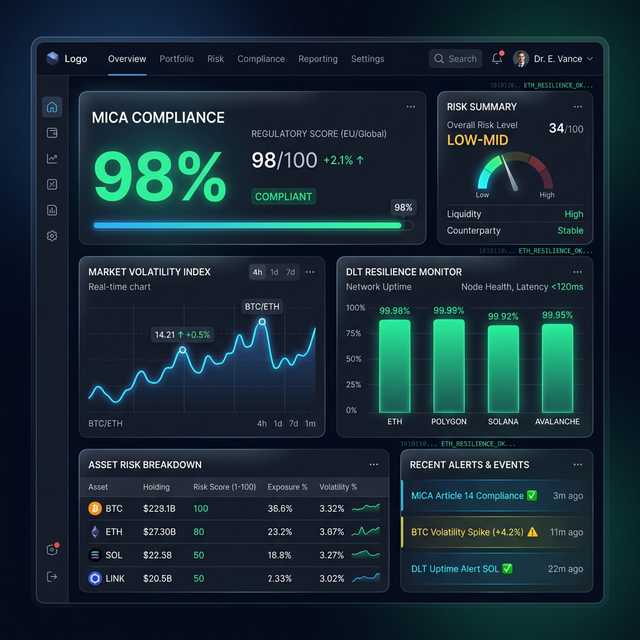
DCM Core advocates for a transition toward **Executable MRM**. By integrating model thresholds directly into the Governance OS, institutions prove their compliance in real-time.
MRM & MiCA FAQ
Master Your Crypto Risk Models
DCM Core provides the computation engines (VaR, Stress Testing) for robust model validation under MiCA.
Read the full framework: Blockchain Risk Governance (EU 2026)
View the complete framework on our Pillar Page or return to the Strategic Hub.