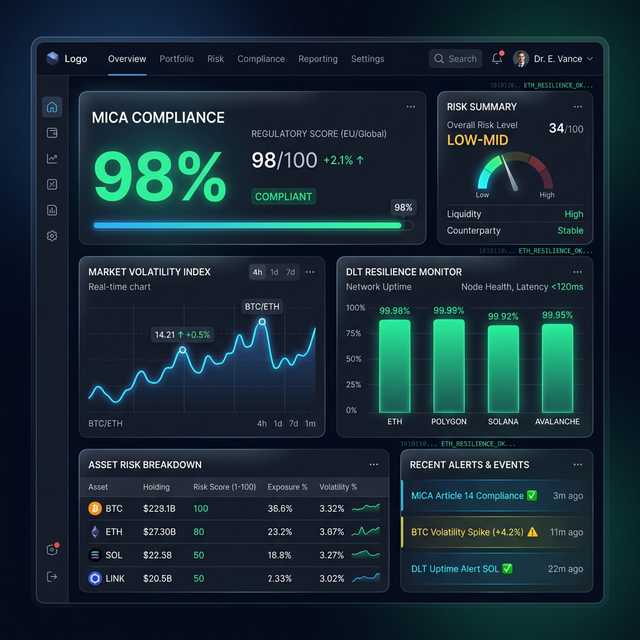
The Complete Guide to Blockchain Risk Governance (EU 2026 Edition)
As the European Union moves from exploration to strict enforcement of **MiCA (Markets in Crypto-Assets)** and **DORA (Digital Operational Resilience Act)**, traditional banking governance models face their most significant evolution in decades.
| Persona | Strategic Priority (Goal) | DCM Core Solution |
|---|---|---|
| Chief Risk Officer (CRO) | Balance sheet stability and regulatory capital. | Monitoring VaR & Stress Test Engine. |
| Chief Tech Officer (CIO) | ICT Resilience and DORA compliance. | Audit-Ready Architecture & Node Monitoring. |
| Compliance Officer | MiCA reporting and European passporting. | Audit Trail & Cryptographic Transparency. |
For Chief Risk Officers (CROs) and institutional innovation leads, the challenge is no longer simply integrating blockchain, but proving continuous and verifiable compliance in an environment where declarative governance is no longer sufficient.
1. The European Regulatory Landscape: Navigating MiCA and DORA
The regulatory burden for digital assets in Europe rests on two massive pillars. While MiCA provides legal certainty for asset issuance and service provision, DORA ensures that the underlying technological infrastructure is resilient enough to support systemic financial operations.
MiCA: A Prudential Regime for the Digital Age
MiCA is not just a set of rules for startups; it is a full prudential regime. For Tier-1 institutions, MiCA standardizes obligations for stablecoins (EMTs), Asset-Referenced Tokens (ARTs), and utility tokens.
2. From Regulatory Text to Executable Control
The fundamental shift in institutional governance is the transition from **Declarative Compliance** (written policies) to **Executable Governance** (machine-readable controls). This is the core of the DCM Core philosophy: Audit-Ready by Design.
Given that institutional exposure to [Lido-ETH] exceeds the 10% MiCA threshold
And that on-chain liquidity depth falls below 200M EUR
When a stress test is executed by the Scoring Engine
Then a risk escalation alert is sent to the CRO Dashboard
And the event is notarized on the cryptographic Audit Trail
This "Trust-as-Code" approach ensures that risk thresholds are tested against every market movement. It transforms the compliance officer from a manual reviewer into a system architect.
3. Model Risk Management (MRM) for Digital Assets
In blockchain, your Scoring & Stress Testing Engine is your most critical model. Under Basel III and MiCA, institutions must prove that their calibration accounts for "Jump-to-Default" risks and DLT-specific infrastructure failures.
Strategic Governance FAQ
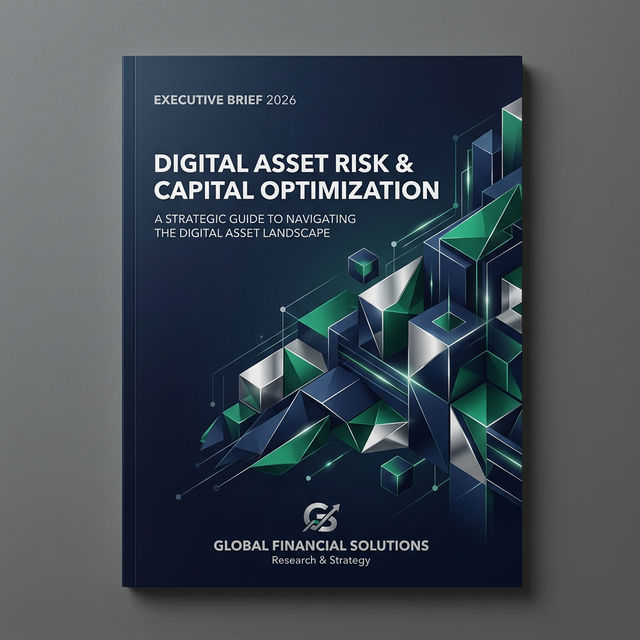
Strategic Brief: MiCA Compliance Implementation
Analysis of the operational and financial impacts of the MiCA regulation on digital asset service providers.
Download Executive BriefReady to Transform Your Governance into a Strategic Advantage?
Discover how DCM Core automates MiCA and DORA risk monitoring for Tier-1 institutions.